12 Myths in Electrical Safety (2025)
 Leaf Team
 2025 / 05 / 21
 4759
4759 (2)_730x575_4c0.jpeg)
In this modern internet age…sometimes it is hard to decipher what is real and what is “not” so real.
In this blog, we will address some common myths in electrical safety. (or at least ones we have been asked about)
Hopefully we can provide some clarity to help you stay safer.
We have broken these up into the following sections:
• Technical Misconceptions
• Behavioral Myths
• Management/Organizational Myths
Let’s get started. In no particular order...

Technical Misconceptions
Myth 1: The voltage is low, so the potential harm must be low.
Low voltage circuits can be deadly if the current is high enough. The danger of electrical shock is not solely dependent on voltage as current also plays a crucial role.
The human body can be severely harmed by currents as low as 100 milliamperes (mA)
Myth 2: I have turned off the motor/capacitor bank, and therefore there is no energy remaining.
Capacitors and inductors are components that store energy—capacitors in the form of an electric field and inductors in the form of a magnetic field.
When the power is turned off, these components do not immediately release all their stored energy. Instead, they discharge over time, which can pose significant safety hazards if not properly managed.
In high-voltage equipment, capacitors are often used to smooth out voltage fluctuations. These capacitors can store dangerous amounts of energy. Even after the equipment is powered down, the capacitors can retain a charge that is sufficient to cause serious injury or death.
Myth 3: Any rubber glove will always insulate and protect me against shock hazards.
Only properly rated 100% rubber gloves provide adequate protection against electrical shock.
Not all rubber gloves are created equal when it comes to electrical insulation. Only gloves specifically designed and tested for electrical work, provide the necessary protection against electrical shock. Always check the rating before use.
Myth 4: Anything under 1.2 cal/cm² is safe to work on live.
You can still receive burns or have your clothing catch fire below 1.2 cal/cm². The stated incident energy applies when you are at the working distance, but it gets higher the closer you are to the conductors. Additional arc flash PPE will be required for any part of the body that is inside of the arc flash boundary, typically the hands and arms
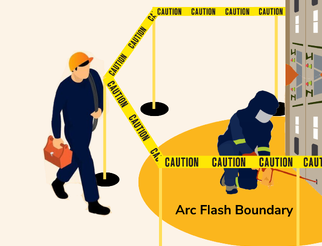
Myth 5: If you stand directly outside the arc flash boundary, you are completely safe.
The arc flash boundary is the distance at which the incident energy equals 1.2 cal/cm², the onset of second-degree burns. Standing just outside this boundary doesn’t guarantee complete safety in every circumstance.
Myth 6: FR (Flame-Resistant) and AR (Arc-Rated) PPE are the same.
While all AR clothing is flame-resistant, not all FR clothing is arc-rated. AR PPE is specifically tested to protect against the intense energy of an arc flash, whereas FR PPE is designed to resist ignition.
Using non-arc-rated FR gear for arc flash protection can leave workers vulnerable to serious injuries. Derek Sang, from Bulwark, chats more about the differences on our Podcast below:
Behavioral Myths
Myth 7: “It can’t happen to me” mindset.
Electrical incidents don’t discriminate…As our podcast guest Mike Bahr once said, “Electricity doesn’t give a damn about you.”
Complacency can be fatal. Performing routine tasks can give you a false sense of security and you might neglect to de-energize equipment before performing a seemingly simple repair, thinking it’s quick and safe task.
You might also be someone who has had near misses without consequences and that might develop a sense of invincibility. You might think “I have done this a hundred times without incident.”
However, near misses are warnings that should reinforce the importance of following safety protocols. Always follow safety protocols, regardless of experience or confidence.
Even scarier is having a near miss and not even knowing it. This happens everyday.
Myth 8: Wearing jewelry is fine if you have gloves on.
Metal jewelry can conduct electricity through PPE and create additional hazards. Always remove jewelry before working with electrical equipment.
Wearing metal jewelry while working with electrical equipment poses significant risks, even if you are wearing gloves. Metal is a good conductor of electricity, and if it comes into contact with an electrical source, it can create a path for the current to flow through your body, leading to electric shock or burns.
Additionally, jewelry can get caught in machinery, causing physical injuries.
Myth 9: Safety procedures can be bypassed in emergencies.
Emergency situations require stricter adherence to safety protocols. Stress and urgency increase the risk of accidents, making safety procedures even more critical.
Management/Organizational Myths
Myth 10: Everyone who works with electrical equipment is a qualified worker.
Qualification requires proper certification, regular assessment, and ongoing training. Not everyone working near electrical equipment is necessarily qualified.
Myth 11: Only licensed electricians need electrical safety training.
Anyone working near electrical equipment needs appropriate safety training, including operators, maintenance staff, and even cleaning personnel.
Electrical safety is not just the responsibility of licensed electricians. Anyone who works in proximity to electrical equipment, regardless of their role, must have a basic understanding of electrical safety to prevent accidents and injuries.
This includes operators, maintenance staff, and even cleaning personnel who might make contact with electrical systems during their routine tasks.
Myth 12: Using the table method is as effective as an Arc Flash Study
Using the "table method" to calculate arc flash levels is a valid way to keep your employees safer when dealing with hazardous equipment. However, it is not nearly as robust or effective as a full arc flash study.
The table method will suggest a higher PPE level than an arc flash study most of the time, and there is also a higher risk of making an error when you do this manually.
Conclusion:
Remember, electrical safety is everyone’s responsibility.
By addressing these topics, we hope this improves awareness and promotes safer practices for your facilities and your workers.
Please reach out if you have other myths we missed!
Interested in improving your facilities electrical safety but not sure how to start? There are two ways we can help you:
- Learn even more about Electrical Safety Training from our industry experts or by downloading our Free Ultimate Guide To Improve Electrical Safety In Your Workplace.
- Don’t have time to read our free resources? Request a Free 15 minute call with an Electrical Safety Expert today by booking here -> Book Now
LOOKING TO LEARN MORE ABOUT ELECTRICAL SAFETY IN YOUR WORKPLACE?
Download our free guide and let our industry experts teach you about Electrical Safety and how you can manage your programs with confidence. Trust us, whatever stage of your journey, we've been there. Download your free copy.

_322x246_42d.png)
 Confidential. Secure. No Spam.